
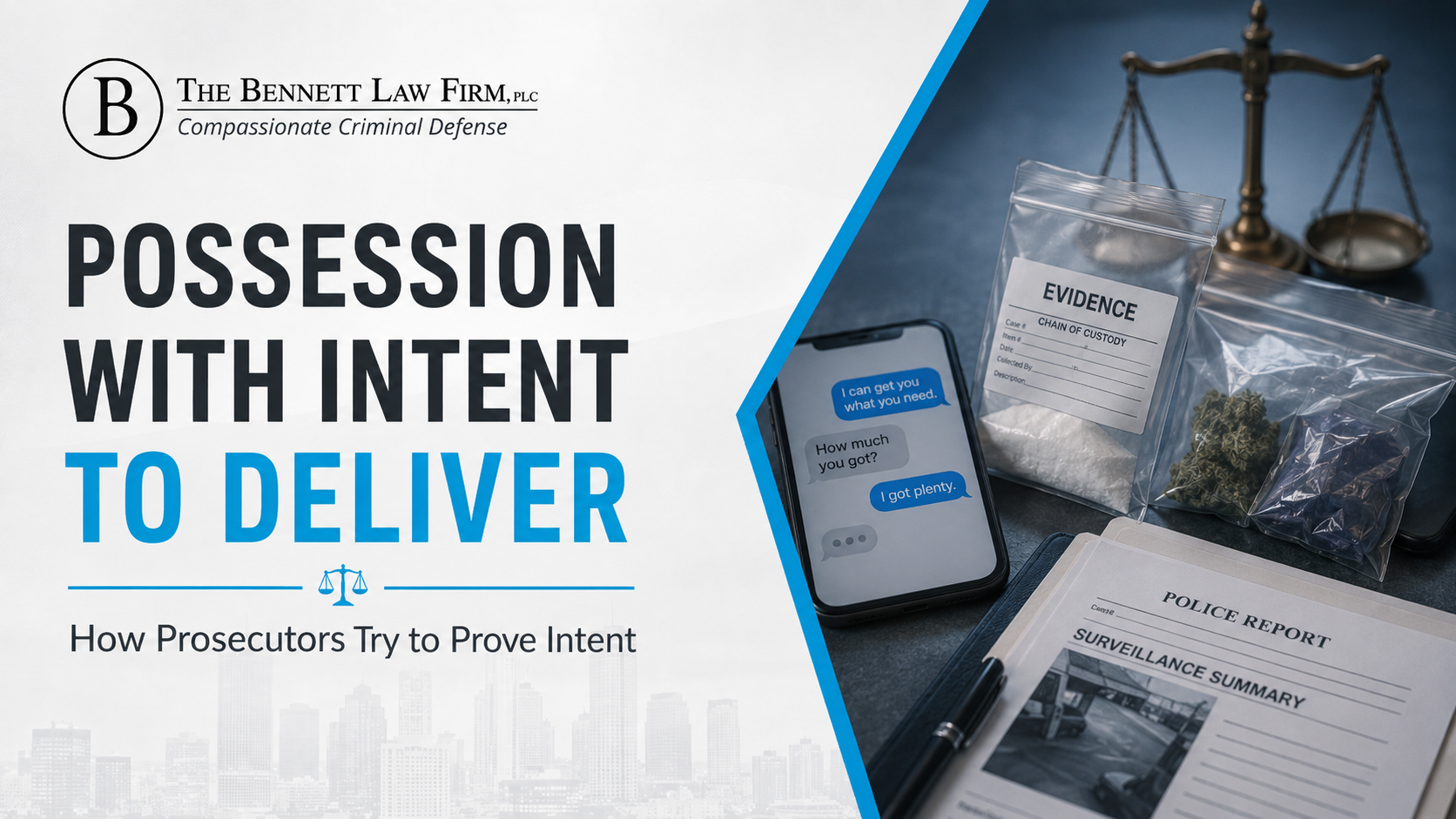
Possession With Intent to Deliver in Michigan: How Prosecutors Try to Prove Intent
A possession-with-intent-to-deliver charge is more serious than a simple possession allegation because the prosecutor claims the drugs were intended for distribution. The accusation may be based not only on the substance itself, but also on packaging, cash, communications, location, witness statements, or an investigator’s interpretation of the evidence. Those inferences can be challenged.
Key Takeaways
- Intent to deliver is often alleged through circumstantial evidence rather than a witnessed sale.
- Presence near drugs does not automatically establish constructive possession.
- Search-and-seizure issues can determine whether key evidence is admissible.
- Phones, messages, payment apps, and location records can be important but must be properly connected and interpreted.
What Is Possession With Intent to Deliver?
Michigan law prohibits manufacturing, creating, delivering, or possessing with intent to manufacture, create, or deliver a controlled substance. The primary statute is MCL 333.7401.
The prosecution must prove more than the presence of a substance. It must connect the accused to the substance and establish the required intent. The potential penalty depends heavily on the drug, quantity, record, and surrounding facts.
How Do Prosecutors Try to Prove Intent?
Intent is often proved through circumstantial evidence. Prosecutors may point to separate packaging, scales, ledgers, cash, multiple phones, customer messages, location data, observed exchanges, controlled buys, or statements.
No single item automatically proves intent. Cash may have a lawful source. A scale may have an innocent use. Messages may be ambiguous or belong to another person. The defense should examine each fact and the way investigators obtained it.
What Is Constructive Possession?
A person does not need to hold a substance physically to be accused of possessing it. Prosecutors may rely on constructive possession, arguing that the person knew about the substance and had control over it.
Shared homes, vehicles, hotel rooms, and workplaces create important questions. Presence near drugs is not necessarily the same as legal possession. Ownership, access, fingerprints, DNA, statements, keys, mail, and electronic evidence may all be relevant.
How Do Searches and Search Warrants Affect the Case?
Drug cases often begin with a traffic stop, consent search, probation search, confidential informant, controlled buy, package interception, or search warrant. A defense lawyer should examine whether police had lawful grounds and whether the search stayed within its permitted scope.
Evidence obtained through an unconstitutional search may be subject to suppression. The warrant affidavit, officer testimony, video, and timeline can be critical.
Can Phone Evidence Be Used?
Text messages, encrypted-app records, photographs, search history, contacts, payment-app activity, and location information may be used to argue intent. Investigators may also seek information from service providers.
Digital evidence must be connected to the accused and interpreted in context. Questions may arise about who used the device, whether a warrant was sufficiently particular, whether extraction was complete, and whether messages were altered or misunderstood. Our internet and computer crimes page explains related issues.
When Can a Drug Case Become Federal?
Federal involvement may arise when allegations involve larger distribution networks, interstate activity, mail or shipping services, federal task forces, firearms, or other factors. State and federal authorities may share information, and the final charging decision can significantly affect sentencing exposure and procedure.
Our Michigan federal crimes page discusses federal investigations and prosecutions.
What Defenses May Apply?
Potential defenses depend on the facts but may include lack of possession, lack of intent, unlawful search, unreliable informant information, mistaken identity, insufficient connection to a phone or account, chain-of-custody problems, or laboratory issues.
A defense can also challenge quantity calculations, drug identification, enhancement allegations, and the prosecution’s interpretation of ordinary objects. Review our Michigan drug crimes page, Metro Detroit drug-crimes page, and article about drug possession charges in Southfield.
Frequently Asked Questions
Does having separate bags automatically prove intent to deliver?
No. Packaging can be evidence, but the prosecution must prove the full charge beyond a reasonable doubt.
Can everyone in a car be charged when drugs are found?
Police may arrest more than one person, but the prosecution must establish possession and intent as to each accused person.
What if the drugs belonged to someone else?
That can be a defense, but it must be evaluated against statements, location, access, digital evidence, and other facts.
Should I give police the password to my phone?
Do not make that decision without legal advice.
Talk With a Detroit Criminal Defense Attorney
If you are facing possession-with-intent-to-deliver or another drug charge in Michigan, contact The Bennett Law Firm, PLC.