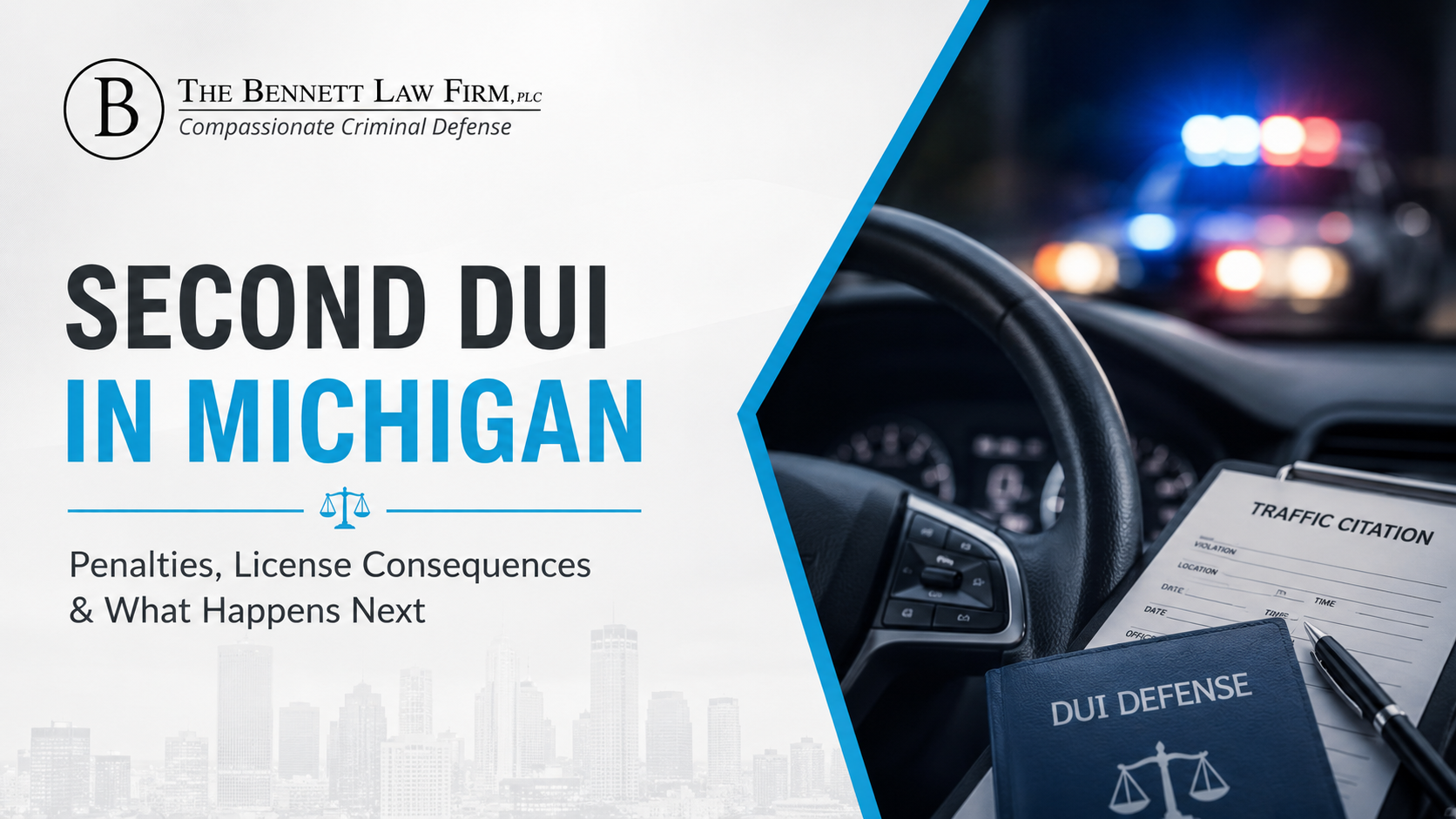
Charged With a Second DUI in Michigan? Penalties, License Consequences, and What Happens Next?
A second drunk-driving arrest can feel far more serious than a first case, and in Michigan it usually is. A prior conviction can affect the possible sentence, driver’s license consequences, bond conditions, treatment requirements, and the strategy used from the beginning. An arrest is not a conviction, however. The prosecutor must still prove the new charge, and the evidence should be examined carefully before important decisions are made.
Key Takeaways
- A second DUI can carry substantially greater criminal and licensing consequences than a first offense.
- The earlier conviction, the new evidence, and the timing of both cases must be reviewed carefully.
- License issues may involve both the criminal court and separate Secretary of State procedures.
- Early review of video, testing records, and bond conditions can help prevent avoidable mistakes.
When Is a DUI Considered a Second Offense in Michigan?
Michigan generally treats an operating-while-intoxicated charge as a second offense when the person has a qualifying prior conviction within the applicable statutory period. The date and type of the earlier conviction can matter, so the driving record and court documents should be reviewed rather than relying on memory.
Michigan’s primary drunk-driving law is Michigan Compiled Laws 257.625. It distinguishes among operating while intoxicated, operating while visibly impaired, high bodily alcohol content, controlled-substance cases, and offenses involving injury or death.
What Penalties Can Follow a Second DUI Conviction?
A second conviction can expose a person to jail, fines, probation, community service, substance-use assessment and treatment, vehicle sanctions, and other court-ordered conditions. The range can change depending on the precise charge and aggravating facts, such as an accident, a child passenger, a very high alcohol level, an alleged chemical-test refusal, or drug impairment.
Judges may also consider the prior record, performance on earlier probation, treatment history, and the facts of the new incident. A defense strategy should address both the legal evidence and the practical sentencing concerns.
What Happens to Your Driver’s License?
The criminal case and the driver’s license consequences are related but not identical. A conviction can trigger action by the Michigan Secretary of State, while a refusal of a chemical test can create a separate administrative issue. Deadlines may be short.
The Michigan Secretary of State license restoration page explains the general process. Someone who has lost driving privileges after repeat alcohol-related convictions may eventually need to prove sobriety and eligibility at an administrative hearing. Our article on getting a driver’s license back after multiple DUIs discusses that process in more detail.
What Happens at Arraignment and While the Case Is Pending?
At arraignment, the court advises the accused of the charge and addresses bond. Conditions may include alcohol or drug testing, travel restrictions, no driving without valid privileges, ignition-interlock requirements, or treatment. Michigan law contains specific arraignment procedures for misdemeanor drunk-driving cases in MCL 257.625b.
Violating a bond condition can create a separate problem. Even when a person disagrees with a condition, it should be followed unless the judge modifies it.
What Evidence Should Be Reviewed?
Important evidence can include the reason for the traffic stop, dash-camera and body-camera video, field sobriety testing, breath or blood testing, maintenance and calibration records, witness statements, medical information, and the timing of alcohol or medication use.
Potential issues can include an unlawful stop, an unreliable test, a break in the chain of custody, an inaccurate assumption about who was driving, or evidence that does not establish impairment beyond a reasonable doubt. Not every defense applies to every arrest.
Can a Second DUI Be Reduced or Dismissed?
A reduction or dismissal depends on the evidence, prior record, prosecutor, court, and legal issues. No attorney can promise a particular result. In some matters, motions challenging the stop or testing can significantly affect the case. In others, negotiation may focus on reducing consequences and protecting the person’s long-term ability to drive and work.
Our Michigan drunk-driving defense page, Metro Detroit DUI page, and Novi DUI article provide additional information.
Frequently Asked Questions
Will I definitely go to jail for a second DUI in Michigan?
Jail is a serious possibility, but the outcome depends on the charge, facts, record, court, and applicable law.
Does a prior DUI always count as a second offense?
Not necessarily. The date, jurisdiction, and legal classification of the prior matter can matter.
Can I drive while the case is pending?
That depends on your license status, any administrative action, and bond conditions. Do not drive unless legally permitted.
Should I begin treatment before court?
A voluntary assessment or treatment plan can sometimes help, but it should be discussed with counsel so that it fits the legal strategy.
Talk With a Detroit Criminal Defense Attorney
If you were arrested for a second DUI in Detroit, Royal Oak, Southfield, Warren, Troy, Novi, Bloomfield Hills, or elsewhere in Metro Detroit, contact The Bennett Law Firm, PLC for a confidential consultation.